Saturday, February 25, 2012

About landscape painting


Recently I went to see the David Hockney exhibition at the Royal Academy, “A bigger picture”. Hockney, now in his seventies, remains active and prolific. Most of the work has been created in the last ten years and a lot of it was done specifically with the show in mind, especially for the large walls available to him. All the paintings on show are landscapes, revealing Hockney as a proud defender of a great English painterly tradition going back to the likes of Constable, Turner and Cotman. Most of these landscapes are of Yorkshire and as such deeply resonant to me as a fellow Yorkshireman. Hockney makes a strong case for figurative painting as a pleasure to the eye. Pretentious intellectual snobs may dismiss it as neither difficult nor challenging but they forget that art is intended not only to provoke but also to produce beauty.


The paintings are a celebration of nature in its wonderful ordinariness close to home. This is art that makes us look again at our surroundings and enjoy them more. It is also the art of a real skilled craftsman (Hockney cheekily remarked that he had personally made all the works on show, unlike he implied some of his contemporaries). Hockney is a fine draughtsman with a delight in colour. He has created some huge works (several metres across) made up of many canvases which fit together in a grid producing an effect that is quite physical, you feel yourself entering into the painted woodland.


Hockney has also worked hard at catching the changing seasons, doing the same landscape in spring, summer, autumn and winter (we are reminded of the series of paintings by Monet, eg of haystacks). He wants to show us the paradoxical permanence of ever changing nature in its repeated cycles. It is as if in old age after decades of having painted a great variety of subjects, nature is now what matters most to him and he has been fired with a sense of urgency and enthusiasm to get all of this down while he still has the time. Because of this the paintings have a communicative spontaneity. Some may find the show repetitive, but I found the cumulative result makes landscape painting something far from static.


Some of my favourite painters were specialists in landscapes, I think in particular of Cézanne, Monet and Van Gogh (there’s a few references to Van Gogh in the show, eg hayfields and swirling blossoms).


To begin with, in the history of Western art, landscape was only valued as a backdrop to the human interest, the madonna and child or whatever the subject was. In one of my favourite Brueghels, “Hunters in the snow”, the landscape is magnificent, it structures the painting and is an important part of it, but ultimately it is only there to provide a framework for the human activity. It is also in fact totally imaginary, being a composite of familiar Flemish villages and Alpine vistas remembered from the road to Italy.


I suppose some of the first landscapes for landscapes’ sake were done by such 17thC Dutch painters as Van Ruisdael. These are flat landscapes with great lowering brooding skies and the odd windmill or belfry. In fact it was at this period that the Dutch word “landschap” was imported into the English language to describe this kind of painting. In a way these landscapes which are based on local reality are an extension of Dutch Golden Age genre paintings, that is scenes from everyday life, such as people in taverns, church interiors, servants pouring milk. Unlike their Italian counterparts painting biblical and mythological scenes on commission for the church and nobility, the Dutch painters were seeking to sell pleasing scenes to merchants who could relate to the subject matter.


A further boost to landscape painting came in the early 19thC with the Romantic movement’s admiration of nature. This is when the dramatic natural scene really takes off in such works as Caspar David Friedrich’s strangely remote and intimidating mountains. This is also the period of Constable and Turner. Slightly later, in France, Corot and the Barbizon painters start taking their easels outside to paint countryside scenes not far from Paris and this feeds directly into the ever popular work of Monet, Sisley, Pissaro and the like. Landscape for a time becomes the dominant genre in the 19thC. Then Cézanne starts to analyse the geometric structure of the view and Van Gogh to simplify the lines and colours stamping his own personality on it. From there it is a short step to Kirchner’s bold expressionist Alpine landscapes, but the interest of artists is already attracted to other more urban subjects and is beginning to veer off into abstraction. So it is quite refreshing after so many decades of neglect to see artists like Hockney return to landscape painting.


The bulk of my own paintings over the years have been landscapes. For the artist a landscape is a convenient subject, it’s there for free and it keeps still. it doesn’t move about as much as a person. As a painter you just have to choose your viewpoint, set up and get on with it. It isn’t of course quite that simple, as outdoors the light keeps on changing with the rise and fall of the sun and the passing of clouds. It tends to change much faster than you can get it down. One technique to deal with this challenge is seen in Greenaway’s film “The Draughtsman’s Contract”, where the artist is commissioned in the late 17thC by a nobleman to do a series of views of his country estate. He works on each picture in stages during a given time slot. I have often myself done a sketch on day one and then coloured it on successive days at the same time of day. That of course depends on the weather not having changed.


What I describe here holds for working in the field only from observation. You can of course make a few preliminary sketches and then go away and work from memory back in the studio. Before the impressionists and the outdoors movement, that was actually the usual technique, not least given the size of canvas worked on and the taste for fairly precise brushstrokes requiring time for the paint to dry before continuing. Hockney has used both techniques, working outdoors from observation and in the studio from memory, and you can compare the results in the show.


I myself prefer to paint from observation. For a start it’s a great excuse for sitting still outdoors and since I’m painting on a small scale with watercolours there’s no imperative reason to be indoors to do it, unless it’s really cold and I’m looking out of the window. Actually it’s the process of making the picture which I find as rewarding as the take home souvenir. It’s being forced to really observe and allow myself to become impregnated with the scene. During the drawing It’s about making countless decisions of my own on how to convert three dimensions into two instead of merely copying the flattening of the camera lens. During the colouring it’s about how I attempt to convey the impression of colour I perceive. Even from one position we see from a variety of viewpoints as we move our eyes and change our focal distance. We subjectively highlight certain shapes and patches of colour which become for us focal points even if in terms of overall surface area they are insignificant. How often have you taken a photograph and been disappointed with it because it is not what you thought you saw ?

When they are successful I find my landscapes closer to how I remember a place than a photograph, in the sense that they convey a certain feeling as much as what is inevitably an imprecise graphic record.


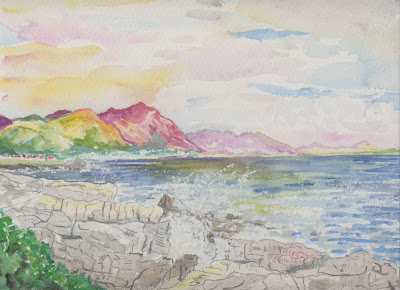
Here are six of my landscapes.


Cévennes, France

Julian Alps, Italy

Hermanus, South Africa

Elba, Italy

Hvar, Croatia

Dolomites, Italy

Wednesday, February 1, 2012

About my reading in 2011


About my reading in 2011


Looking at the list of books I read In 2011, I seem to have increased the share of non-fiction, though not greatly compared to 2010.


My big achievement in this area was to read Keynes’ “General Theory of Employment, Interest and Money” which I had failed to finish on a previous attempt. The trick is not to get stuck on the pseudo mathematics “let x be..” and the intimidating looking formulae. You just skip over them because he nearly always immediately goes over the same argument again in less abstract and plainer English. He is very convincing and it’s hard to diagree with him, so you end up really wishing his policies were being acted on more right now. The great thing about Keynes is that he sees money not as an end in itself but as a means to satisying needs. For him the real purpose of economic policy should be to provide employment and this is too important a task merely to be left to the markets and speculators, for they fail at it. There is a clear rôle for the state. In our twenty-first century, post-cold-war world of roaring unfettered capitalism, that is of course an unwelcome message to big finance. But Keynes’ time will come again, the economies of the developed world are in free-fall, and his policies are what we need in order to return to a fairer world of shared prosperity. Not that Keynes was a socialist by any means, but he grasped why certain economic behaviour is actually counter-productive, even if that may seem counter-intuitive.


An easier but very enlightening read on contemporary economics is Lanchester’s “Whoops” a great explanation of how we got where we are in the current crisis; but offering no quick-fix solution, although he clearly points in the direction of my own preferred option: nationalize the banks, because they have failed us, lost the plot and are starving the real economy of its lifeblood.


In the popular science department, I read Deutscher’s “Through the language glass” a potentially intriguing book for a linguist on the subject of how the language we speak may influence the way we think. In the end he spends most of his time on just two examples: the well known fact that words for colours are not an exact match between languages; and the fascinating case of some remote tribal languages that base directional information not on the changing egocentric view of the speaker (eg left, right) but on a fixed geographical framework (eg north, south).


I was going to read all of Gibbon’s “Decline and Fall of the Roman Empire” but somehow ran out of steam half-way through volume 2 around about Justinian. Volume 1 is a cracking good read though.


I read a couple more books by De Botton “Status Anxiety” and “Architecture of Happiness” but I’m starting to find him a little inconsequential; although he writes elegantly and makes some good points, he can give you the feeling of lacking an overall compelling argument which leads you to a conclusion.


Weightier indeed was J.S. Mill“On Liberty” and “On Utilitarianism”, two basic texts of political philosophy.


My Hellenist friend Umberto gave me a good essay by Grosdent “La Grèce existe-t-elle?”, which is amusingly written in the style of a Platonic dialogue. The subject turns out to be quite topical with the ongoing crisis (Greek word of course) in Greece. Grosdent takes to task the Western idealizing vision of an Ancient Greece that probably never was but which causes disappointment when confronted with the Modern Greece. He argues that the modern is indeed a descendant of the ancient, it’s just that we were a bit naive about the ancient.


Rousseau’s “Confessions” I guess I should still include under non-fiction, though they have clear literary pretensions. They are in fact two books. The first is quite disarmingly frank and a fascinating read. In the second book his confessions start to get more paranoid and self-justificatory. However, while on the subject of himself as a young man he has no particular axe to grind and this is a refreshingly sincere warts-and-all autobiography. I certainly frequently thought “what a prat”, but this perhaps is the point as he challenges us into questioning some of our own unreflecting behaviour, certainly when young and more spontaneous. Clearly the biggest problem with Rousseau is that he gave away his own children for adoption and then proceeded to pontificate in vast tomes on education. What a prat! I’m sorry but there’s no way around that one.

I also read “Le contrat social” which like many French monuments is not all it’s cracked up to be. This short text is a bit overly descriptive of existing systems and skimpy on ground-breaking political thought; it is rather lightweight compared to Hobbes and Mill. The French intellectual establishment is good at self-publicity, whereas the English, in so far as it exists, tends to forget its own heroes.


I also re-read some of Pascal’s “Pensées”, actually as it’s name suggests a collection of often brilliant insights though never mustered into a coherent whole.


I turn now to fiction. Last year I got seriously into audio-books for very long car journeys, so one or two of these titles were actually listened to rather than read, but I think we can still count that in this survey.


I re-read Dostoievski’s “Crime and Punishent”. I still think a great book, but it doesn’t get any less strange and let’s be frank, Raskolnikov must be pretty unhinged to kill just out of curiosity.


New to me on the classics front was Defoe’s “Moll Flanders”, a ripping yarn whose resourecful heroine endears herself to the reader notwithstanding her breaking of several moral codes.


Stendhal’s “Chartreuse de Parme” is another epic adventure story, this one also offering a study of ambition and of the Italian psyche.


Another French classic was Balzac’s “Lys dans la vallée” which is worth persevering with through all the descriptive passages for its rather unexpected outcome which puts the rest into a different perspective.


The author I read most of last year and who was new to me was Emile Zola. I listened to the early murder story “Thérèse Raquin” and read six of the series of twenty novels about related characters from the same large family, the Rougon-Maquart, living in France in the mid 19thC, so almost contemporary with him. Zola wanted a real setting for his stories or “natural” as he called it, but to our modern minds it is more often what we would call urban and industrial. He researched each novel carefully and includes fascinating descriptions of how things work rather than the rather boring superficial descriptions of how things look typical of Balzac. In fact the setting takes on a life of its own and plays a leading rôle as one of the characters, an infernal machine often consuming and destroying the working man. Thus Germinal is about coal-mining and an ill-fated strike, la Bête humaine about the railways and living with a murder on your conscience, l’Assomoir about working class alcoholism, l’Oeuvre unsuccessful artists contemporary with the impressionists, Nana about the theatre and high-class prostitution, and l’Argent about the stock exchange and speculation. These seem surprisingly modern subjects for novels over a century old. In terms of plot, I find Zola refreshing, instead of yet another love story, improbable action packed adventure or whodunnit, the interest relates to the outcome of a more down to earth drama. Zola’s characters are frequently weak and driven by money and/or lust. His dialogues are convincingly real. I like him, so I may yet read the other fourteen.


After all last year I read my 17th and 18th Graham Geene the early “England made me” set mainly in Stockholm and the late “The Human Factor”, a realistic cold-war counter-espionage story. Perhaps, with their eye for sordid local detail and what really motivates people, Greene and Zola have a lot in common.


And so, finally, to recent fiction.


On a Jonathan Coe recommendation I bought the acclaimed Japanese novelist’s Murakami’s “Wind-up bird chronicle”, which like many books I buy would probably have adorned my shelf unread for a long time had it not been for a theatrical adaptation of it I was going to see at the Edinburgh Festival. Anything Japanese brings with it a certain sense of other-worldliness, something for which I think the expression “cultural difference” is too polite to render the utterly different take on life. Coe said he admired Murakami’s writing for the way in which everyday life serves in it as a trigger for profound insights into the human experience, which is in his way what Coe does in his writing. Only Coe is Western and Murakami is Japanese. So Wind-up bird turns out to be startlingly original, certainly for a Western reader, and often quite odd, even unsatisfying, but definitely not boring and sometimes actually quite poetic in its imagery in a way that stays with you afterwards.


The American Jonathan Frantzen has a huge reputation, and I loved “The Corrections” written in 2001. He is not very prolific and his next novel “Freedom” only appeared in 2010. I think it is good but not as good as “the Corrections”. I also had troubles with it stylistically and I suspect that his choice of a simple English close to the colloquial American vernacular will make it age quickly. Still it is very much a novel for today about what is wrong with America today.


Mathhew Kneale’s “English Passengers”, which won the Whitbread prize for a first novel 10 years ago, is a styslistic tour de force being written in as many different styles as its various narrators. It’s a great many-layered story, both funny and moving, initially about how a Manx smugglers’ ship gets chartered for a crackpot vicar’s quest to find the Garden of Eden, but ultimately about 19thC British colonial racist treatment of Tasmanian aborigines. The ending is brilliant.


Finally let me talk about Joe Powell’s “Breaking of eggs”. The title comes from Stalin’s famous quote comparing making a revolution to making an omelette, “it can’t be done without...” The hero is a Polish born communist sympathizer living in Paris who used to make his living writing tourist guides about Eastern Europe. The fall of the Berlin wall and state socialism changes all of that and he embarks on a journey of political and self-discovery, realizing he has been living in a world of self-delusion and that many lives including his own were broken by the old system. It is a fascinating story written in a thoughtful, sensitive, uderstated way that evokes a huge chunk of post-war history we have been hastily brushing under the carpet or summarizing in convenient slogans.


So that’s what I have been reading over the last year. I hope you may be stimulated to try some of these titles for yourself.


Tuesday, January 10, 2012

About... About being here !5)


Dear reader,

Welcome to season 5 of about being here.

Last year’s posts sort of tailed off as I became more interested in drawing and painting than writing.

Or maybe it’s just that blogging is far more of a long rainy winter’s evening type activity which in the spring and summer is overtaken by more active and less reflective pursuits.

Be that as it may I did actually reach last year’s objective of ten posts, so I’ll stick with that for this year.

Enjoy.


ABH


Thursday, September 22, 2011

About the euro and speculators


One of the reasons behind the creation of the euro was that member states were fed up of their currencies coming under constant speculative attack, the ultimate aim of which was to destroy the ERM (European exchange rate mechanism). It seemed safer to band together in a single currency so as to be stronger together and thereby avoid the weakest in the pack being picked off by predators.

Twenty or so years later it is now the euro countries’ sovereign debt that finds itself under speculative attack from the obscure and modern vindictive gods who are collectively known as “the markets”, probably with the ulterior motive of destroying the euro itself. “Plus ça change, plus c’est la même chose.” Maybe the answer is in turn to band together in a single debt to avoid the weakest being picked off, that is to issue euro-bonds.

At present, however, this is a non-starter as the self-styled virtuous northerners are not ready to subsidize their perceived profligate southern partners. If views on this are to change it would require a degree of “economic governance” or enforced fiscal integration and discipline that is incompatible with current forms of democratic control.


I have recently been reading Keynes’ “General theory” (1936) of which many passages still seem highly relevant. A few quotes will illustrate: “A conventional valuation which is established as the outcome of the psychology of a large number of ignorant individuals is liable to change violently as the result of a sudden fluctuation of opinion due to factors which do not really make much difference to the prospective yield.” It is on these fluctuations that the speculator makes his profit. He is concerned “not with making superior long-term forecasts of the probable yield of an investment over its whole life, but with foreseeing changes in the conventional basis of valuation a short time ahead of the general public.” Keynes concludes that “Speculators may do no harm as bubbles on a steady stream of enterprise. But the position is serious when enterprise becomes the bubble on a whirlpool of speculation. When the capital development of a country becomes a by-product of the activities of a casino, the job is likely to be ill-done.”


Speculators then play a game of making short term gains on fluctuations in price that feed on often irrational expectations. They are in no way interested in making a long term investment that gives them a slow return as an income, merely in making a quick profit on the difference between buying and selling prices. They are not interested in the good of the economy and how that benefits you and me. They do not care for economic fundamentals, they are only interested in guessing in which direction the herd will next stampede before it does. Mass movement is indeed now reinforced by such things as computer programmes that automatically sell securities when they fall below a certain price. Then there are rules on the kinds of assets which banks have to hold as capital which oblige them to off-load bonds when their rating falls below a certain level.


Speculators thrive on uncertainty. It is in their interest to spread rumours and provoke wild swings as it’s on the difference between the ups and the downs on which they make their money, not from any reasoned long-term investment in what is economically sound. Speculators are like fraudsters who take out an insurance policy on a house and then burn it down to make a claim. Only the house they are setting fire to is the one in which you and I live. We need to lock them up so we can live in peace and security.


Keynes argues that speculation is the disadvantage of having a system geared towards liquidity; that is the ability to sell anything at short notice to turn it into cash. He jokingly argues that to deter speculation, purchases of securities should be made more like marriage, difficult to render asunder. The much debated idea of a financial transaction tax in part seeks to slow down the mad spiral of speculative transactions and would be a step in the right direction if it could be made to work. Only without all countries on board it would merely displace financial business from one continent to another. The financial transaction tax also has the attraction of taking money back off these wretched people for the benefit of the state which previously bailed them out. The financial sector of course who would have to pay the tax argues strongly against it. Instead of listening to the arguments of the “too big to fail” brigade we should consider what is best for the real economy. The truth is that the vast bulk, about 90%, of financial transactions in markets today are purely speculative.


Keynes was of course talking mainly about speculators’ behaviour on the stock market; the dilemma now is that this same behaviour is being applied to government borrowing, which intrinsically is a totally different form of financial activity and investment. Let me explain why.


Ever since ancient times states have tended to find the need to spend more money than they could levy through taxes and have therefore had to borrow. Initially this was often in order to fight wars. As notions of what the state was about evolved in the last century the purpose of borrowing became more to fund the providing of stimulus to the economy and a social safety net. Latterly however, it has also been to bail out the financial sector itself. Over the last three years because of this the average rate of OECD country endebtedness has risen from 78% to 92% of GDP. In the same way as in the past if the state didn’t borrow enough, it could lose the war, at present starved of cash it will probably likewise fail in these three modern aims. So basically by refusing to lend to sovereigns at a normal rate of interest the financial sector is shooting itself in the foot, by slowing down the economy and depriving itself of its life-belt.


Normally for a bank, the difference between lending to a sovereign and to a private company is what follows and this basic premise needs to be recalled during the current hysteria. Businesses can go bust so you may lose the money you lent them. Countries, however, do not usually go bankrupt: governments can make their citizens and businesses pay more taxes; or, quite simply, they can print more money (though that would have the effect of depreciating the monetary value of the loan in real terms, so creditors might not find it a good idea to lend to countries who tend to do this). Therefore, usually, lending money to a sovereign state is risk-free and should command a low rate of interest, whereas lending it to a private company is iffy and should command a high rate. So far so good, and for decades this was the basis for a cozy relationship between states and the financial sector that lent to them, which even includes the man in the street making a modest investment for a rainy day. Buying sovereign bonds as long as they give you a return higher than the rate of inflation represents a safe place to park savings and is an essential part of your portfolio: not sexy but reliable. This basic relationship grounded on confidence has now been shattered by the behaviour of speculators who have scared markets into losing that confidence.


Having lost interest in poorly performing shares speculators have turned their attention to bonds. The trouble is they treat bonds like shares, not for keeps and a slow return, but for buying and selling for a quick profit. They have introduced into the bond market an instability that just wasn’t there before, creating huge problems for states and the real economy. The old assumption that the sovereign will always pay has been undermined by hysterical talk that he might not repay your loan. It’s a bit as if suddenly, for no real reason other than a malicious rumour, Joe Bloggs’ bank suddenly becomes convinced he is not able to keep up his mortgage payments and so decides to double his rate of interest overnight because in their eyes he has become risky. As long as Joe Bloggs quitely was paying 3% he was perfectly solvent and could go on paying forever, now he has to pay 6% very soon he will be reposessed. The “markets” by demanding usury type rates of interest of perfectly viable states will inevitably force them into default. This bad-mouthing becomes a self-fulfilling prophecy. They are playing a very dangerous game and they need to be stopped for our general good.


How did we get here?


Firstly, as mentioned already, following the finacial crisis and subsequent recession shares seemed to be going all one way and were less of interest to speculators so they turned their attention to bonds.

To cause a stir and create uncertainty (as is their modus operandi), they started to put it about that ratios of public debt to GDP that had been high and a fact of life for decades were all of a sudden unsustainable, when in fact for some time now states and in particular euro area countries bound by the Stability and Growth Pact have been patiently working on bringing the public debt gradually down. Only unfortunately it had recently shifted back up because of the need to bail out a previously irresponsible financial sector which had got itself into a long-term mess by making too many bad loans for a short-term profit. It seems a bit rich that the very people who the generous taxpayers helped out should now roundly turn on states for their burgeoning debt which has been caused only by rescuing them in the first place. In fact it beggars belief, but this is the obscene truth.


First and foremost in rocking the boat are of course the ratings agencies. These same people, Standard and Poor’s, Moody’s and co. are those who recommended investors to acquire sub-prime mortgage backed assets as triple A. Not only did they fail to see the financial crisis of 2008 coming they actually caused it. Quite why any creedence should be paid to these people is beyond me. And yet what they say moves markets. Even worse respecting their ratings is actually part of our banking capital adequacy rules. That needs to be changed immediately. We need a properly independent public body to recommend which sovereign bonds are investment grade, not some outfits owned in turn by the New York based financial sector.


Have you ever also stopped to wonder why it is that it is euro area sovereign debt which is under attack and not US debt, when in absolute terms US debt is bigger and in relative terms just as high ? It is true the Americans can print as many dollars as they like and so will always be laughing all the way to the bank, but as I said earlier a depreciating currency in itself is not a particularly good recommendation to invest in that country. No, actually apart from a slight downgrade by Moody’s last August when Congress came perilously close to not adopting the package that at the eleventh hour prevented a US default, a downgrade which was not actually commensurate with the risk, these American ratings agencies are staunchly patriotic.

It’s always the European countries they are gunning for. To put it simply, some Americans (and many British too) do not like the success of the euro in becoming the world’s sceond currency and challenging the dollar’s hegemony. If they could sink the euro that would suit them. More immediately though, by attacking the euro area, they divert attention from the parlous state of the US public finances and economy.

Let me hasten to add that oficially the American administration, rather than the private sector, is deeply worried about the euro as they realize a disaster in Europe would be bad news for the US economy.


Since I’ve shared one conspiracy theory with you, try also this one for size, think it over.

Following the end of the cold war and the crowing victory of capitalism over socialism, following the disappearance of an alternative widespread narrative to keep capitalism in check, the real big vested capitalist interests in the financial sector are greedy for more and more and more money and power. Let’s be frank this is where the real global power lies, many multinationals have a turnover bigger than the GDP of a medium-sized state. In fact big business and the financial sector would like to see the disappearance of the state altogether as it gets in the way of their freedom to do business, what with the state’s annoying tendency to tax them and curb their activities with rules and regulations. They conveniently forget that it has been the state that has boosted the economy for their benefit when the market has failed and that it is the state which has saved them from going under during the financial crisis.

No, they want to reduce the state. They lecture us that it is unsustainable, living beyond its means, profligate, irresponsible, that it cannot afford things which it actually already could when in was much poorer immediately after the war (education, health care, social benefits etc). What they are in fact against is redistribution away from their rich selves towards the poorer. It is not for the rich few, led by the speculators, to decide what public policy is, it is for democratically elected governments. We should not let ourselves be dictated to by them.


In fact their policies are wrong and self-defeating. In Keynesian terms what we need right now is not austerity and spending cuts but government stimulated consumption to boost employment if we are to avoid a serious recession. In the country where I live, Belgium there has been no government with powers to take new initiatives for over a year, so there have not been the same cuts as in other euro countries, and guess what, Belgium has the highest growth rate in the euro area.


So what of Greece ?

It’s true that Greece only entered the euro on the basis of falsified accounts which didn’t show the real position of its public finances and it should therefore never have joined. However, decision-makers at the time were happy to turn a blind eye (as indeed they had already done towards Italy’s and Belgium’s debt): it was politically expedient to let Greece in just in time for the launch of the notes and coinsin 2002, that way of the 15 EU member states at the time all 12 who wanted to be in (i.e. except United Kingdom, Denmark and Sweden) could be.

The Germans later insisted on the Stability and Growth Pact to enforce fiscal discipline on euro members but that in turn soon lost all credibility when among the first not to meet it were Germany and France themselves who were let off its strictures.


I personally don’t think all of this matters much in the sense that the euro is a political project as much as an economic one and its creation was a supreme act of political faith and commitment to European integration, as much as a bold economic experiment. The numbers to a certain extent were window dressing based on theory rather than practice. Romano Prodi, the President of the Commission, once famously described the pact as “stupid” for not permitting expansionary economic policy to be pursued by governments when needed. He then had to come and eat humble pie before the finance ministers (I was there) but he wasn’t wrong.


The fact of the matter is as a currency the euro has retained its value well against the dollar for over a decade and has become the world’s second currency. A currency that is the accepted means of payment among 327 million people because of its sheer mass is not about to disappear overnight. Although sound public finance is one of the euro’s entry criteria, that doesn’t mean it’s about to implode because several of its members according to its own criteria do not have sound public finances. It may well depreciate even if it hasn’t done so much yet, but it’s not going to suddenly disappear just because it hasn’t been around for that long. There is this totally unrealistic hype that if a member defaults that’s the end of the euro. In the United States a number of states in the federation, including California, have technically been in default but that has not changed much about the dollar.


The notion that Greece might leave the euro is also absurd. There is no treaty provision for exit, the process of joining is described as “irrevocable”. There is no drachma to go back to. Even if there were, Greece would be far worse off having to pay back its debts in a currency (euro) inevitably appreciating against its own (new drachma). Just imagine anyway the glee of the markets if they managed to force Greece out. Having tasted blood the next day they would be baying for Portugal, then the day after that Ireland, then Spain, then Italy. There would be no end and the euro would certainly unravel. Greece’s exit is the last thing the euro needs.


In the meantime Greece may well default. So what. The euro will fall in value against the dollar and even Chinese renimbe (but not against the Swiss franc as last month they pegged themselves to us, so the euro can’t be all that bad, after all the Swiss aren’t stupid financially) but that would be great news for our exports and jobs.

Some banks may go under and maybe it’s about time we let some go instead of this “too big to fail” nonsense.

I remember as a sixth-former being told by Sir Keith Joseph (a Tory grandee at the time) the great capitalist myth that the entrepreneur is a noble being who takes a risk and may be successful or may equally lose his shirt. It seems today that there is a general reluctance on the part of the financial sector to lose any clothing at all. Moral hazard rules.

Yes and our pension funds will all take a hit, that’s yours and mine. The finacial sector’s problems will feed again into the real economy dragging us all down. Maybe then we will have learned our lesson and should just go ahead and nationalize them all, because let’s face it their job is too important to the economy to be left in the hands of a few self-interested gamblers. Then we could oblige them to lend to governments at a reasonable rate of interest in return for services rendered. Yes, the probably forthcoming Greek default poses some interesting scenarios.


Yet in all of this the euro itself will not go away and those who would have you believe that are just milking your anxiety so they can speculate on it.


Thursday, July 14, 2011

About self-portraits


Self-portrait as gardener
(See "About gardening")

At the start of the year I wrote that I would be trying to draw and paint more this year. After several months I have just finished a project of doing six self-portraits engaged in favourite occupations. This is not intended as an exercise in narcissism. Indeed, the portraits may seem to be unflattering and not particularly true to life. They are more in the spirit of this blog an attempt at self-description, or should I say self-depiction.
The main reason artists go in for self-portraits is so that they can practise on a model that is endlessly patient and sits still in exactly the desired pose. The drawback is that this implies looking at yourself in a mirror so the poses are limited to being able to see yourself. It also inevitably leads to a fixed stare and unsmiling face, best sent up by Courbet in his self-portrait as a madman, as the artist concentrates on trying to get himself "right". Then there has to be a decision on correcting from left to right, which I have applied to my hand (one only as the other is employed) but not always to my hair.
The choice of background is always significant and in these portraits it is intended as symbolic rather than real. Impossibly, the garden has flowers from different seasons in bloom at the same time, while the forest and moutains are stylised from memory.
I have worked on a larger scale than usual, A3, and in a new medium for me, watercoulour pencil. Having got used to the technique and worked out what I was trying to achieve, after completing the series I redid the first one, the gardener.


Self-portrait as cyclist
(See "About cycling")


Self-portrait as interpreter
(See "About interpreting")


Self-portrait as mountaineer
!See "About mountains")


Self-portrait as guitarist
(See "About playing the guitar")


Self-portrait as artist


Monday, March 21, 2011

About nature

Nature is of course beautiful and wonderful. It is the subject of countless superbly filmed BBC natural history documentaries. It is something in quest of whose greatest sights we are ready to travel the continents. Or more modestly, closer to home, we are ready to bask in admiration of, as birds twitter by a gurgling brook in the woods.

And yet I had a friend at university who used to say: “I don’t know why people get so excited about nature. Nature is just something that shits on me.”


He was, in his provocative way, reacting against the adoration of nature, a relatively recent trend in the history of thought, which seeks to glorify nature as being, for want of a better word, “natural” as opposed to corrupted by civilization. “Natural” is generally seen as good; note how the word figures so often in advertising. Rousseau’s “noble savage” is emblematic of a desire to shake off the artificial constraints of society and to return to something perceived to be spontaneously purer. “Back to nature” has become a rallying cry from the Romantics onwards, right down to today’s organic farming movement, for all those jaded with the worst excesses of how mankind has organized the economy and society. City-dwellers, including myself, in our spare time have sought to escape to the countryside, to the great outdoors, to embrace and commune with Nature. Painters such as Caspar David Friedrich beautified mountainous landscapes which for centuries had rather terrorized locals. Indeed they were right to be terrified, as once unleashed the brutal forces of nature can in a few moments soon destroy what mankind has patiently and painstakingly constructed over many years. This month’s earthquake and tsunami in Japan are stark reminders that nature does shit on us, big time.


Civilzation, beginning with agriculture, has striven to keep nature at bay, to claim from it a space for man that must be constantly defended. Virgil writes in the “Georgics”: “Though you drive nature out with a pitch-fork, she will return”. Generally, this Sisyphean endeavour can be made easier and more successful by trying to work with the grain of nature rather than against it. By respecting the patterns of nature, our activities may be more fruitful and sustainable. Hence, it is not a good idea to build on the flood-plain of a river or in a known avalanche path. Still nature is nothing if it is not unpredictable; or rather its recurrent patterns being often on a geological timescale may be imperceivable to man whose life is but the blinking of an eye by the same measure. And yet, man may reckon that a risk is worth taking. The soil around a volcano is so fertile that it may be worth cultivating it and living on it, on the assumption that the next eruption is a thousand years away. Whether building a nuclear power plant in a seismic area is a risk worth taking is, of course, another matter.


In modern times the godess-like Nature has come to be replaced with the more scientific Environment (to which administer also priests, but in white coats). The crucial thing is that man is essentially and rightly still filled with the same veneration and awe before it. The message remains, "Respect Nature / the Environment, or it will bite back": as in, overheat the planet and you will be flooded out along the coastline; or pour enough toxins into the soil and you will choke on your food. Make no mistake, Mother Earth will go on, with us or without us, shrugging us off if we are too inconvenient. Species come and go as part of the ever changing pattern of evolution that is life. At any one time the whole system (Gaia) is in balance; but if parameters change, such as average temperature, then a new balance will come into being which may or may not include us. It is the Earth / Nature that is robust and beyond our irreparably harming it, and it is we human beings who are the endangered species. Nature does not depend on us, nor can it be tamed.


As a mountaineer, I have learned to appreciate the unspoiled open spaces, majestic forms, fresh air and calm of the Alps, while at the same time to be acutely aware of the limitations of my own abilities and endurance, which often require that I must turn back without reaching my objective. I must respect nature.


As a gardener I have learned that my aesthetic is not really natural, that I have to constantly remove spontaneously growing plants which I have designated as “weeds”, in favour of ones I have artificially introduced. Yet I still let my chosen plants grow where they most thrive rather than where I might otherwise place them. It is possible then to strike a compromise with nature.


This compromise has characterized human development. It is perhaps only more recently that post- religious scientific man has abandoned his earlier humility and reverence before nature and assumed a more exploitative, unsustainable stance, which we are now coming to see as doomed to failure.


There need of course be no antithesis between man and nature, because seen properly, as an animal, man is also part of nature. All the laws of the natural world apply to man himself. As with the rest of nature, man’s number one objective is to survive and reproduce, perpetuating the species. And so man’s life too is characterized by cycles of birth, growing up, becoming in turn a parent, ageing and death.


On a daily level too man is ruled by his body, his need for food and drink, sleep and shelter. Our body itself has all its organs in common with other mammals, only the brain is somewhat more developed. As such our body is our first-hand and most familiar example of the fitness for purpose that is typical of nature’s designs.


The beauty of nature is first and foremost functional, the product of efficiency and the laws of physics. There is an underlying logic behind the patterns and forms in nature. That is why we see these shapes repeated through the plant and animal kingdoms and in the topography of the earth on the full range of scales from the miniature to the gigantic.


Man’s own aesthetic is informed by nature. As we, like other animals, are in form symmetrical on a vertical axis, that same vertical symmetry is our recurrent aesthetic ideal from classical architecture through to modern design. Other shapes in nature also inspire us: we borrow columns from the mighty forests, we copy the perfection of the circle seen in the sun; we fequently use botanical forms as decoration. Our own main contributions to design, on the other hand, which are the right angle and the straight line, seem crude compared to the gradual elyptical curves of nature, which have been lovingly copied for example by the baroque or art nouveau styles.


Yet in the end, all our artistic attempts remain artificial, clumsily stylized next to the infinite, fine and sophisticated variety of form, texture and colour visible in the natural world. It is a world in which the forms are instantly recognizable but the individual specimens endlessly varied: this is a tree, but it is different to the next one; just as I am a man but am different to the next one. This is the joy of observing nature. Our copying of nature in art may be imperfect but it can at least teach us to use our eyes in a different way, to look again and see afresh.


The longer you sit still outside, say in the woods, by a river or the sea, on a hilltop, the longer you look, the more you observe, then the more you see and absorb. Then you in turn may lose yourself and become absorbed yourself into surrounding nature. This is what we mean by contemplating nature: transcending the self, becoming part of the whole again. This sitting still outside, doing nothing, contemplating nature is not time wasted: it is one of the most profitable things you can do with your life; it is a moment of becoming truly alive.


Monday, March 7, 2011

About Rome


I have just spent a few days in Rome, at first working in the outskirts and then staying on for the weekend in the centre with our friends Umberto and Silvia. Rome never ceases to fascinate and delight me. It is inexhaustible and offers a life-time of discoveries. When asked the question, “What is your favourite city ?” I unhesitatingly answer “Rome”... at least that is as a tourist, of course whether I would want to live there full time is another matter.


For a start Rome is quintessentially Italian and I just enjoy being in Italy. When Italy unified through the “risorgimento” there was some hesitation as to what its capital should be, but it could only possibly have been Rome given its prominence throughout history, even if Milan may be more important economically.


Rome gives you the style and cheerful chaos you expect of Italy, the beauty, the exuberance, the architecture and art, the good food. Rome has it all in spades.


I simply find Rome stunningly beautiful. I adore the crazy juxtaposition of styles and periods. The more uniform grandiose elegance of Paris just doesn’t do it for me in the same way. London is lively and fun, but it is not beautiful. In Rome the sun shines, the light is gorgeous, the colours are rich: the blue of the sky, the ochres of the buildings, the iridescent greens of the towering pines, the glowing white marble of the façades, all serve to make a feast for the eyes.

Rome is not overdone, it’s not manicured and over-restored like Vienna, and the centre is compact and on a human scale, unlike say Berlin. (I mention here in passing the names of some of my other favourite cities).

Walking remains the best way to get about the centre and that’s just what you find people, both locals and tourists, doing in droves. History is everywhere and yet it is a modern, bustling, living capital.


I first went to Rome on a school trip when I was about thirteen. For the benefit of schoolboys learning Latin, the teachers’ focus was on things Ancient Roman and so I remember being suitably amazed by the Forum and Colosseum.

My next visit was at eighteen en route for Greece, rather roughing it that time, but still able to afford a good cheap meal with plenty of wine. From that trip I remember returning to the centre late at night from a concert in the EUR in an unbelievably packed out bus with people hanging off the side. The driver decided there was no point stopping en route and drove straight to the last stop. Once there the bus disgorged its contents and the drinking fountains disappeared under a scrum of passengers. The drinking fountains so frequent in Rome and essential in the summer are one of the legacies of the great civilzation of the Roman Empire.


Later at twenty-one, by when I could speak a little Italian, on my way back from Naples to Germany on a much delayed train (which was typical of how you travelled around Italy in those days) I fell in with a bunch of Roman lads with who I was standing in the corridor. When it became clear that I had missed my connection at Rome, they insisted I should stop over with them. In a flat in a fairly non-descript neighbourhood in the outskirts I was treated to full Roman hospitality with plenty of good home cooking and local wine. On the wall was a map of the Roman Empire and pointing to it the proud father of my host family explained how his city had for a long time been the centre of the universe, even far away Britain had been one of its colonies.


Since I started working I have visited Rome fairly regularly both for my job and for pleasure. My longest stay lasted for eight days on an Italian language refresher course in 1998, during which I got to visit many Italian institutions based in the capital such as the Parliament, Central Bank, City Hall and RAI TV.


On more recent visits we have been guests of our friends, Umberto and Silvia, who have a lovely flat from which you can see the Aurelian wall and San Giovanni in Laterano. Umberto now works at the Italian Parliament, and has an office in an old palazzo overlooking a beautiful patio. On his office wall hangs a centuries old painting; every office has one, with of course a hierarchical pecking order, so as you get promoted you get to display a more famous old master.

He loves to show us hidden away treasures such as Roman ruins visible under a new hospital building, neglected churches with interesting paintings or some of the more original small old shops that still survive in the centre.

Once, when their flat was too full as both families’ children were also there, we stayed nearby in a pilgrims’ guest-room accessible through the entrance of a baroque church. Breakfast was served in the monks’ old vaulted refectory. This former convent is located right up against the Roman wall and monks still tend a market garden inside the remains of a small Roman amphitheatre incorporated into the city wall.


This is typical of how, in the crowded city centre, historic spaces are used for everyday purposes and new buildings are constructed on top of and around previous ones from earlier centuries.

It’s always been like that: the impressive Roman temple of the Pantheon with its huge dome acts as a memorial church; the medieval fortress of Castel Sant’Angelo is built atop of Hadrian’s mausoleum. It’s not uncommon to see old Roman columns incorporated into the walls of more recent yet still venerable buildings. The town mansions of noble and papal families are recycled as ministries and embassies. The eternal city lives on.


You can’t always get into some of these buildings, so on this last trip it was great to have an opportunity to visit the inside of the Palazzo Farnese, a huge renaissance pile partly designed by Michelangelo and home to the French embassy. The ambassador’s vast office has wonderful frescos by Carracci. It was once also the seat of the Napoleonic secret police and is hence the scene of Act 2 of Tosca.

We also visited the gallery in Palazzo Colonna which is only open on Saturday mornings.


These palaces belonged and in some cases (like Colonna) still do belong to noble families who made vast fortunes by ascending to the Papacy. The Popes were not so much religious leaders as monarchs of the largest state in Italy. More than upholding the faith they were interested in amassing wealth and securing dynastic succession for their barely camouflaged offspring. They were not ascetics but enjoyed the good life and were also great patrons of the arts, which served to display their opulence and preserve their memory. Thus the Popes endowed the city with monuments, in particular the magnificent fountains such as Bernini’s in Piazza Navona. The many fountains of Rome attest to an exquiste taste in the urban environment.


The curious thing about Rome’s art collections is that they are not all together in a national gallery but dispersed among the once private galleries of such papal families as the Barberini, Borghese, Doria-Pamphilj, Colonna, Spada and Corsini, plus of course in the Vatican. It can take you a while to get round them all. Then of course there are many works which are still in situ, in the place for which they were commissioned, such as the Caravaggio paintings and Michelangelo sculptures in churches, not to mention the frescoes, most famously in the Sistine Chapel.

With all this fine art you can quickly reach saturation, so it’s good to take a break from the sight-seeing after you’ve taken in one collection and to stroll about the streets observing how everyday life continues and then chill at a café . In fact it would take you years to see everything.


The Roman Catholic Church obviously is inescapable in Rome, as the headquarters of this truly international organization is located in the Vatican, an entire independent state within the city. By the way I once got a glimpse of the inside of it by taking the regular bus from the museum exit back to St. Peter’s Square. Priests, nuns and pilgrims of all different languages races and colours can be seen and heard everywhere in Rome.

I’m not sure whether anybody knows exactly how many churches there are in Rome, but it’s agreed there are certainly over 900. They range from the small romanesque, such as San Clemente, to the colossal over the top baroque, such as Saint Peter’s itself, and indeed by force of centuries of long accretion sometimes a mixture of both, such as San Giovanni in Laterano, which is the Cathedral Church of the Bishop of Rome and therefore the second most important church in the city. One style that you won’t see much of though is gothic, that would be too Northern for the Mediterranean feel of Rome. It would also take you years to visit all the churches.


Alongside the omnipresence in Rome of the Church from being the capital of Catholicism, the next great constant in the landscape of Rome are the ruins from being the capital of the Roman Empire. Indeed the very topography of the city goes back to imperial times. The heart of the old city is defined by the great wall erected by the Emperor Aurelian from 270 AD, when it had become clear that the capital actually needed protecting from marauding hordes of barbarians. The Circus Maximus is still a handy central space for important outdoor events. The shape of the smaller Stadium of Domitian forms Rome’s perhaps most beautiful square, the Piazza Navona. Some of the famous seven hills are still topped by important public buildings, such as the City Hall on the Capitoline and the President of the Republic’s Palace on the Quirinal. The largest surviving Roman building, the Colosseum, is often taken as the symbol of the city.


I have recently been re-reading Gibbon’s “Decline and Fall of the Roman Empire” and was therefore in the mood for some ruins, so on my free afternoon the other Friday I headed down to the Forum to stroll around and sit in the sun. This is something that European travellers, writers and artists have done for centuries, sitting, reflecting on the “glory that was Rome”, and sometimes sketching the ruins.

I hadn’t realized until this last trip that Mussolini committed a colossal act of vandalism by driving the wide Via dei Fori Romani right through the historic site all the way from the overstated pomp of the Vittoriale monument to the unknown soldier (commonly known as the “Wedding cake”) to the Colosseum as he felt the grandeur of perspective thereby offered matched his own neo-imperial ambitions. A terrible loss. In earlier centuries you could wander across to Trajan’s column from the rest of the forum.

On one trip we had a privileged close-up view of the bas-relief sculptures that run all the way to the top of Trajan’s column, because an acquaintance of Clara’s was working on its restoration and was able to guide us up the scaffolding around it. The detail, usually too distant to observe closely, is really fine.

If you want to admire the full range of Roman sculpture a visit to the National Roman (Archeology) Museum is a must. They also have some surprising wall paintings which have survived the millenia. The Romans, who are so often admired for their architectural and civil engineering skills, were also no mean interior decorators. Their art is traditionally felt to be less elegant and sophisticated than the Greeks’, not least for its virile glorification of the military, but it would be wrong to underestimate it.


The downside to all of Rome being built on top of ancient ruins is that it is impossible to dig a hole without the Superintendance of Archeological Sites descending and calling a halt while a survey is carried out. The metro has famously spent decades creeping forward. In Fellini’s “Roma” there is a well-known scene where beautiful intact Roman frescoes are found during construction work on the metro, but then suddenly disappear when they come into contact with the outside air. Many of the other scenes in “Roma” filmed in 1972 also seem just as relevant today, notably the traffic chaos and the presentation of the Vatican in the clerical fashion show sequence.


Thirdly then, after being the capital of the Empire and the Church, Rome is of course also the capital of Italy. This is where you put away your guide-book and revel in spectating everyday Roman life. This is in fact a show being put on for passers-by: whether it’s flaunting money and power, dressing up to be noticed, making a scene in a bid to get some sympathy or being funny to get a laugh. At the risk of over-generalization, there is something in the Italian upbringing, with its protective loving mothers and the public fondness of children, which builds a feeling of self-confidence and a desire to be looked at and made a fuss over that clings to Italians through the rest of their lives in a charming outgoing way. This is very much on display in the streets and squares of Rome which remain a public theatre of everyday life, at least certainly more so than in the North. Watching the world go by, witnessing a row between a bus-driver and a badly parked car, going to a popular neighbourhood restaurant, admiring the passing fashionably dressed women can be as good as watching Fellini.


As Rome is the centre of political life in Italy, if you are at all interested, the signs of its presence are never far away: important people stepping into and out of limousines in places otherwise inaccesible to traffic; activists collecting signatures; daubed slogans and layer upon layer of political posters on walls; people demonstrating with megaphones and banners; endless grand buildings occupied by ministries and public bodies. Obviously with Umberto who works for the Parliament acting as our guide, we are made aware of what’s going on.

Like any capital, Rome is also very active culturally and I like to get along to the theatre and temporary exhibitions when there.


One thing I also like about Rome is that the food tends to be very good. There are so many Romans eating out that there are far more proper restaurants for locals than poor quality tourist traps, which is different to the case in Florence and Venice for example. Like any region in Italy, Rome is rich in local specialities which are worth sampling. I’m particularly fond of the vegetable antipasti.


Rome keeps you busy as a tourist, but it keeps you perhaps too busy if you have to live there permanently, in the sense that in a cramped historic city not designed for modern life, the business of everyday living is not always that easy.

Schools, universities, hospitals and so on are short of cash for the numbers of people they have to cater for. Dealing with the administration is a nightmare for the same reason. Sadly, as the administrative centre of Italy, Rome is also a hot-spot for nepotism and croneyism which fill many public offices with people who have no real qualification for their job other than being among the family and friends of those in power and so do little. Corruption in general is widespread, which brings all its attendant inefficiencies to any system. I personally suspect that this has been a constant in the history of the city ever since ancient times and as such deeply engrained in the way of life and thinking of the majority.

Then simply getting about is difficult if you need to do things and transport stuff. In the centre of Rome it is a physical impossibility to park a car. By day the public transport is not so bad, albeit usually packed out, but it is only sporadic in the evening, when it becomes very hard to find a taxi.

And so on.

So much as I adore visiting Rome, I’m not so sure I would really want to live there.


Instead I shall keep on returning as an eternal visitor to the eternal city.